01
Become a seller
You agree to the rules once, under your name. A locked Marketplace folder is then waiting in your inventory at your next login.
Everything in this market was uploaded here on skimi3d by the person selling it, and is delivered straight to your avatar. The rule behind it is one sentence: you list your own creations.
That is what makes the market worth browsing · no bulk packs, no imports, nothing resold from somewhere else.
Having a file is not the same as being allowed to sell it.
If you hold a licence that expressly allows reselling · CC0, a bought commercial licence, a written permission · you may list it. You name the licence when you put the set up, and it is printed on the article's page for every buyer to read.
Your own work stays the norm. The licence line exists so the rare honest case has a door, not so the rule has a hole.
The creator check runs by itself. The moment a folder from Marketplace is read, every piece in it is looked up · and you are told on the spot whether it may go up or not. No queue, no waiting for an answer, and no listing that quietly never appears.
Textures are fingerprinted as well and compared against every texture on this grid. If two look alike, that set waits for a person to look before it reaches the shelf · a check, not a verdict, because the same comparison also catches two colourways of one set.
What no grid can see is whether you made a file yourself. That part is your word · it carries your name and the date, and buyers can report a set they recognise from somewhere else.
You agree to the rules once, under your name. A locked Marketplace folder is then waiting in your inventory at your next login.
One item, or a folder if the thing is made of several pieces. One folder is one article · name it after what you are selling.
A folder inside Marketplace, not a file lying loose in it · loose files are never read.
We read every piece for its creator, and the article keeps only the rights that all of its pieces share. Nothing is listed on your say-so, and nothing is read until you ask for it.
One piece without Copy takes Copy from the whole article · a buyer would otherwise find out after paying.
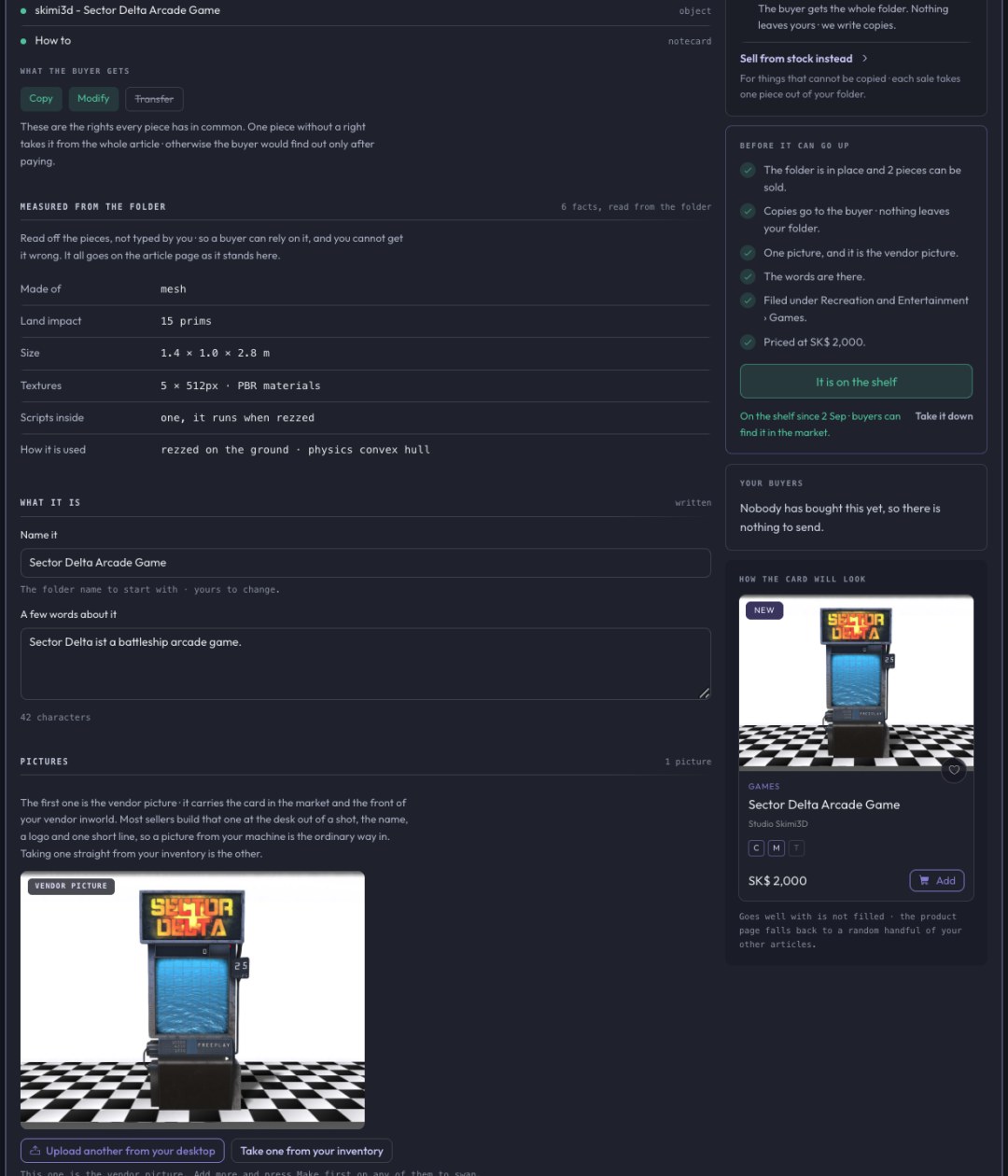
Your words, your pictures, a category out of the market tree, a price in SK$, and the address of the spot where it stands. It is one card, so nothing you type can be lost on the way to a second page.
The picture comes off your desktop or out of your inventory · the first one is the vendor picture and carries the card in the market.
Nothing goes up by itself. A short list says what is still missing, and the button is out of reach until nothing is. Afterwards the same card is where you change it.
An article whose condition breaks · sold out, folder deleted, price cleared · comes off the shelf by itself and says which one did it.
That much is the catalogue. The other half of selling is the shop you put in the world · a vendor inworld that carries one of your articles and takes the money. How a vendor works is a page of its own.
Name, words, pictures, a category, a price and the place to go and look at it · all of it on the card that shows the folder. No second page, no step path, nothing that can be lost on the way there. And when you want to change something a year later, it is the same card.
One big, the rest in a strip. The first is the vendor picture and shows on the market card and on the front of your vendor inworld.
Chosen one level at a time, as deep as it goes. That is how buyers narrow down, so it is how they come past your thing.
For inworld goods this is the strongest line on the page · it stands there, set up and switched on, and a buyer can walk around it before paying.
Every piece the read found, by name and kind. Nobody has to guess whether the script and the sound are in there.
Not three letters with one struck through, but a sentence each · what the buyer may do, and what they may not.
Logo, a description, a website and one address for the shop itself. A buyer who likes one thing of yours walks in and sees the rest.
Each sale hands over one of the pieces lying in the folder, at the moment somebody pays. Your stock is however many are in there · put in as many as you mean to sell. At zero the article comes off the shelf by itself, and it goes back up when you put another piece in.
They are spent in the market and put towards your account tier and your region rent · they are not paid out in real money. This is a place to trade what you make with the people who live here, not an income.
If a delivery fails, the money goes back by itself and the piece goes back on the shelf. And there is no limit on how much you list · a thousand articles cost you nothing to keep on the shelf.
It is not our income · it is the drain. Nobody is ever paid out in real money, so SK$ is a closed system: what the grid hands out has to leave somewhere, or prices climb until the currency means nothing. Region rent and account tiers are one drain. This is the other, and it is the one that only runs when somebody actually earns.
One number, from the first day, for the newest seller and the oldest alike. No introductory rate that quietly doubles, no tier that buys a lower cut. If it ever has to change, it is announced three months before, and never for a sale already made.
If a listing is turned away, nothing happens to your item · it stays fully yours to use, wear and share inworld. It just does not go on the public market. And nothing ever leaves your inventory when you sell: buyers get copies written for them, or, from stock, the piece you put in for that purpose.
We put the money back when the fault is ours. A delivery that never arrived is the clear case, and it settles itself · the buyer gets the whole price back, fee included, and the piece goes back on the shelf. Nobody has to ask for it.
Everything else is between the two of you. If a thing is not what you expected, or not built the way you hoped, write to the seller · they have a name and a shop here, and most of this is sorted in two lines. We run the market, we do not judge whether a build is good, and there is no return window for having changed your mind.
If a listing turns out not to belong here at all, it comes off the shelf. Sales already made stay made · what was paid and delivered before that is settled, and nobody is chased for it afterwards.
Visitors from other grids can already find your things over the hypergrid. Buyers can pay by card · somebody with an empty wallet can buy from you: the card buys the SK$ in the same step, and you are paid the same way, in SK$, for the same 5%. Whether a bought item may then travel home with them stays your decision, per article.
skimi3d is a place where the things around you were actually built by the people here. A market full of imported or copied content would drown that out, and quietly take credit and money from whoever did the work.
Keeping listings to original, made-here creations protects the people who make things, keeps prices honest, and means a buyer can trust that what they take home is the real thing · with a name on it, and often an address where it stands.
Landscapes are ours alone · they are made with the grid's own terrain tool and nobody else can list one here. Textures are their own way in · a folder of them is scanned as a set rather than written out by hand. What may happen here at all is in the house rules.
After that a locked Marketplace folder is waiting in your inventory at your next login, and everything else happens on one page.