Sector Delta
Battleship on an 8×8 grid. You set the price, you keep the takings, and the
jackpot pays itself out.
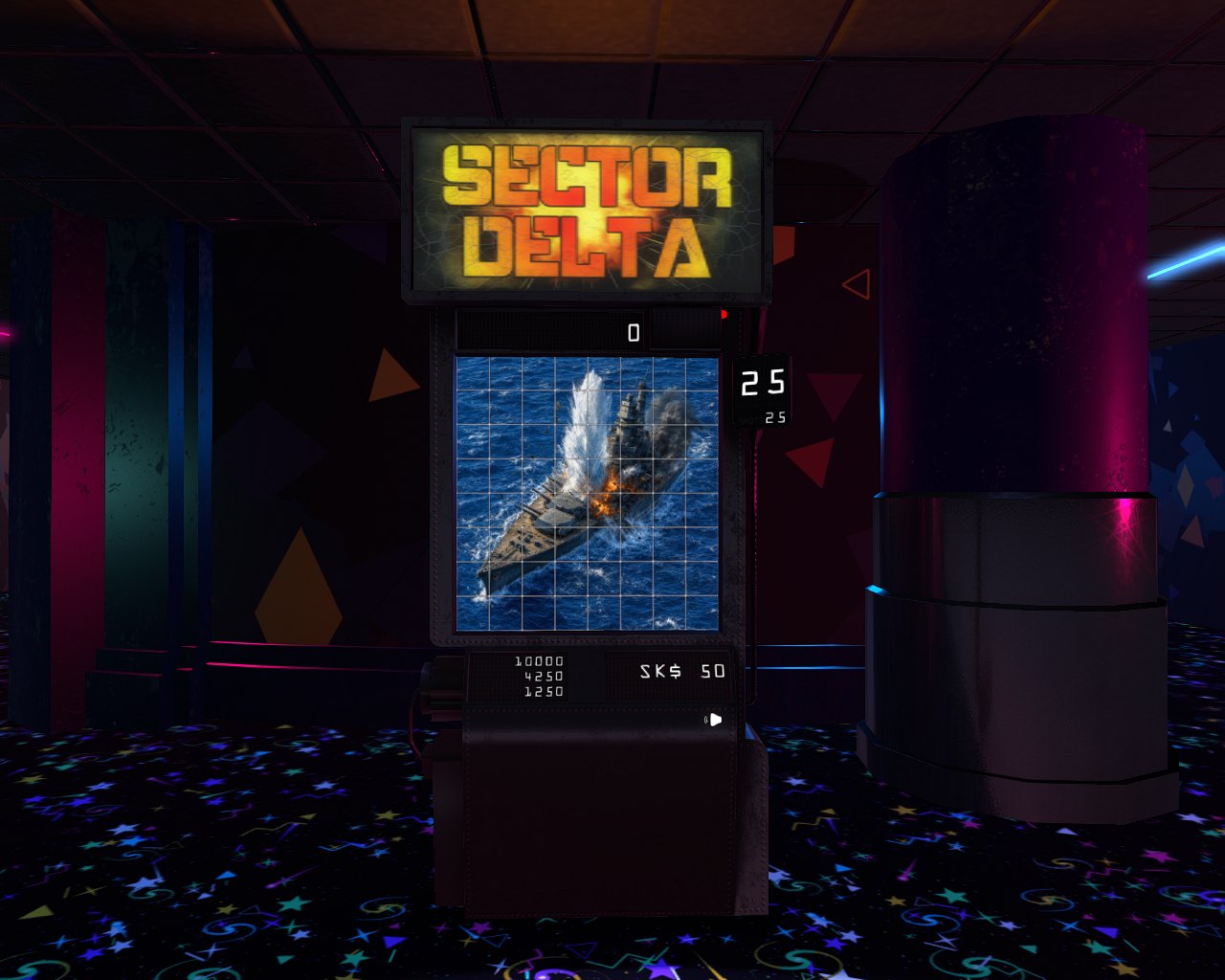
Sector Delta is an arcade cabinet you own and run. Put it on your land, set
what a game costs, and it does the rest: it takes the money, pays your share
into your wallet the moment somebody plays, holds the jackpot in escrow, and
hands the jackpot to whoever is top when the time is up.
Setting it up takes one touch. There is nothing to type. No notecard with
keys in it, no code, no registration. Drop the cabinet, touch it once, and it
introduces itself to the grid, works out that it is yours, and appears under
Your machines on grid.skimi3d.com. It starts on freeplay, so nobody takes
anyone's money by accident.
The game
Five ships are hidden on an 8×8 grid: a carrier of five, a battleship of four,
two cruisers of three, a destroyer of two. They never touch each other. You get
25 shots.
A hit scores. A ship finished scores more. A ship finished with no miss between
your first shot at it and your last scores that bonus twice, and the machine
calls it down clean. Hits in a row build a streak up to five times, so it is
not only what you sink but how cleanly you sink it. Fourteen hits in fourteen
shots beat fourteen hits in twenty-four.
Clear the whole grid and you take the sweep bonus, get paid for every shot you
had left, and then get a fresh grid to spend those shots on.
It is easy to play, and it is quicker to be good at than to be excellent at.
The till
On the website you set two numbers. What a game costs, and how much of that
goes into the pot. Everything that does not go into the pot is in your wallet
before the player has fired their first shot.
Then you decide how the pot goes out. At the end of a period of 1, 3, 7, 14 or
30 days, to whoever is top when it ends. Or to the first player who cracks a
score you name, whenever that happens, even mid game. Or whichever of those two
comes first.
The money is not yours to touch, and not ours either
The pot sits in escrow. You can watch it grow, you cannot reach into it, and
neither can we. That is exactly why players will spend a week climbing towards
it.
Payout is automatic. When the clock runs out or somebody cracks the score, the
pot goes to the winner with nobody pressing anything, and the winner sees their
new balance straight away with a note saying what it was for.
Switching a machine off pays the pot out first, to whoever is top at that
moment. A machine cannot be packed away the night before payday with the pot
still in it. The website shows you what will be paid and to whom before you
confirm.
And the terms hang over the cabinet in plain text before anyone spends
anything: what a game costs, what share goes to the pot, when the pot goes out,
what is in it right now, and whether it is shared.
Scores cannot be faked
The cabinet does not lay out the ships. The server does, and the server
recalculates every score from the sequence of shots. Owning the script gets
nobody anywhere.
More than one machine
Put up a second cabinet and House settings appear above your list: one standing
arrangement for price, share, payout, period and threshold. Every machine
follows the house until you change something on that machine, and then it says
set by hand and runs on its own numbers. A machine you put up next month
inherits the house by itself. You set up once, not twenty times.
Machines that follow the house can share one jackpot, which is how a room full
of cabinets builds a pot worth playing for. Because they follow the house they
necessarily run the same price, so a cheap machine can never feed the pot of an
expensive one. A machine set by hand always keeps its own pot. Your players
fill your pot and never somebody else's.
One list for the whole grid
TOP COMMANDERS is a single leaderboard across every Sector Delta on the grid,
whoever put it there. Your machine counts towards it as long as its six game
values sit on the standard, because that is what makes the scores comparable.
Change a value and your machine runs on your own rules. Scores from it stay on
its own list. That is a real choice and it is allowed, it just costs the shared
one. Each value on the website shows the standard next to it, so you always
know which side of the line you are on.
The grid list pays no money. Every pot belongs to an operator and is won at a
machine, not on the grid list. Somebody can be second on the grid and still
take three pots the same evening.
The scoreboard
A flat board that shows the leaderboard as a picture in the same arcade type as
the cabinet, redrawn after every game. You write one word in its description
and touch it once:
grid             the whole grid
mine             all of your machines
pot              the jackpot, when it pays, and the standings that decide it
a machine UUID   that one cabinet only
The board says on its own face what it is showing, so nobody has to guess. The
board copies like the cabinet does, so hang as many as you like: most operators
put one on pot beside the machine, and a second on grid if they want the
tournament visible in the room.
What it does not do
There is no multiplayer and no playing against each other. It is you against
the machine. It cannot be given away or resold. You cannot load your own sounds
or your own grid texture. Guests from other grids are welcome to play, but a
machine can only be run by a resident here.
The details
Grid           8×8, 25 shots
Fleet          5, 4, 3, 3, 2, never touching
Scoring        1250 a hit, 4250 a sinking, 10000 for a clear grid
Streak         up to five times
Settings       grid.skimi3d.com, account, Your machines
Needs          a place you are allowed to build on
This is the first of our arcade machines. Two more games are being built, and a
cabinet bought today keeps working when they arrive.
What's in the box
The cabinet, one scoreboard, and two notecards: a short How to play for your
visitors, and the owner's manual for you.
What lands in your inventory
4 piecesAll 4 pieces arrive together, in one go · nothing is left behind on the seller.
Pieces inside an object keep their own rights. A script that is copy only cannot be modified, even when the object around it can.