skimi3d Grid Log in Visit the grid
Groundwork / Piece one · planting

You don't buy trees here. You plant them.

The viewer has carried a tool for this since 2004. It went quiet because the economy of these worlds grew around selling objects, and a plant nobody sells has nothing to sell. We picked it up, filled it with our own plants, and made them cost almost nothing.

photograph to come
One species, twenty specimens, no two alike.
What planting is

Click the ground, and something is there.

Open the build tool, pick a species, click the ground. What appears is not a copy of something you chose. It is an individual: its own height, its own width, its own turn, tilted a degree or two off vertical, with the foliage a shade different from the one beside it.

Plant twenty and you get a stand of trees, not twenty of the same object.

There is nothing to search for and nothing to select. Click, and something is there.

Height
Rolled on its own, so a stand has tall and short of the same species.
Width
Rolled separately again · that is what gives you slender and spreading.
Turn and tilt
A free rotation, plus a degree or two off vertical. The eye reads exact plumb as artificial.
Foliage
Shifted a shade. The bark keeps its colour, so the species still reads as itself.
The scatter, drawn
Nothing yet
Nothing planted. Press the button.
Height, width, turn and tilt are rolled per plant

A diagram, not a photograph · the real plants arrive with the library. What it shows is exactly what the tool does: height and width rolled separately, a turn, a degree or two of tilt, and the foliage shifted a shade. The bark does not shift.

Why it costs one

Cheap on purpose.

Land here has a capacity, counted in land impact · how much a parcel can hold before it is full. A bought mesh tree typically costs twenty to forty of it. On a 512 m² parcel you have 234, which buys you six or seven trees and no house.

That is not a discount, it is a statement. Whatever is cheap, people use a lot of, and a lot of planting is exactly what we want. We give up revenue other worlds make, and in exchange we keep the landscape.

One 512 m² parcel · 234 land impact
Bought mesh trees 7 trees, parcel full
Planted here 234 plants, same parcel
Same ground, same capacity. The difference is what you are allowed to fill it with.
Elsewhere the tree is the product and the landscape is whatever happens around it. Here the landscape is the product, and the tree is infrastructure · like a road.
What the product actually is
The library

Everything here was made for this grid.

14 entries are written up so far, each for what it is good at and what it is not. The library grows as the models come out of Blender.

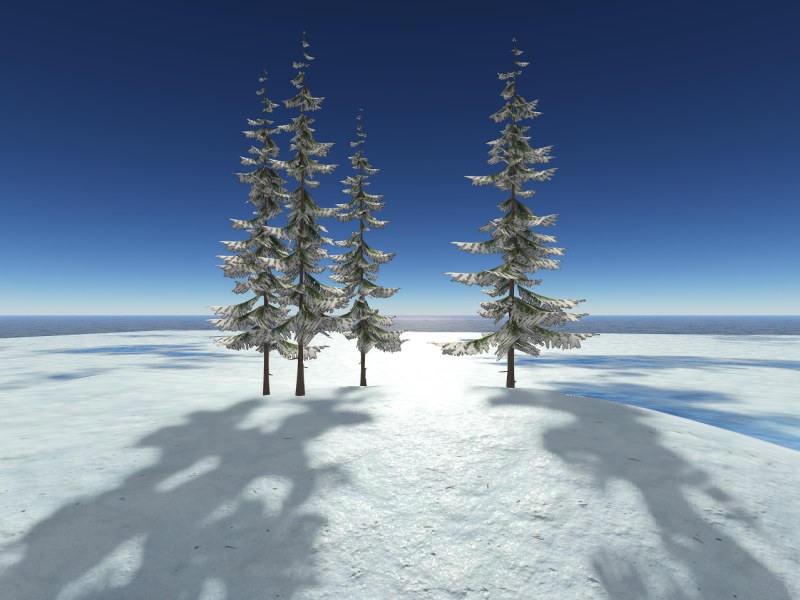
Pine 1

Pine 1

tree

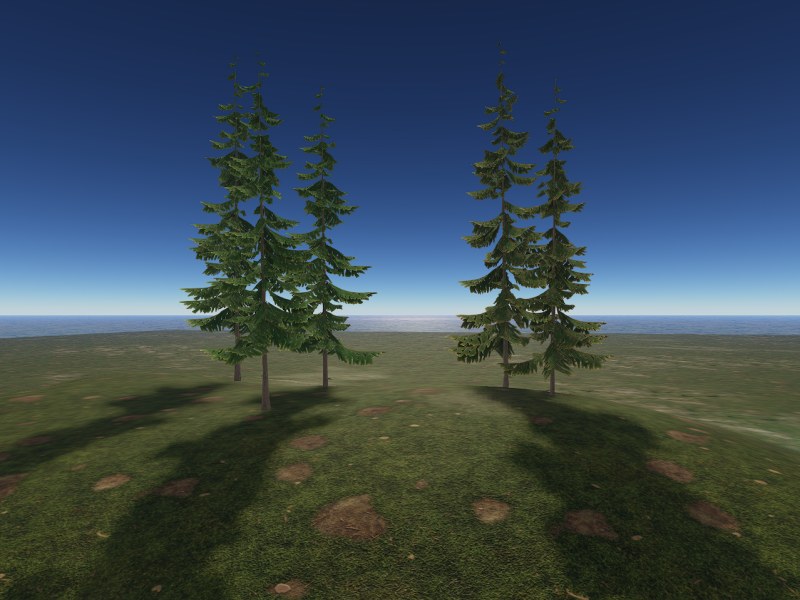
A coniferous evergreen tree with a characteristic pyramidal shape and dark green needles arranged in whorls around the trunk. It grows between 12 and 18 metres tall and works well as a focal point in forest compositions or arranged in groves to create windbreaks and screening effects.

Not for Not suitable for creating dense undergrowth or low ground-level screening due to its tall, narrow profile.
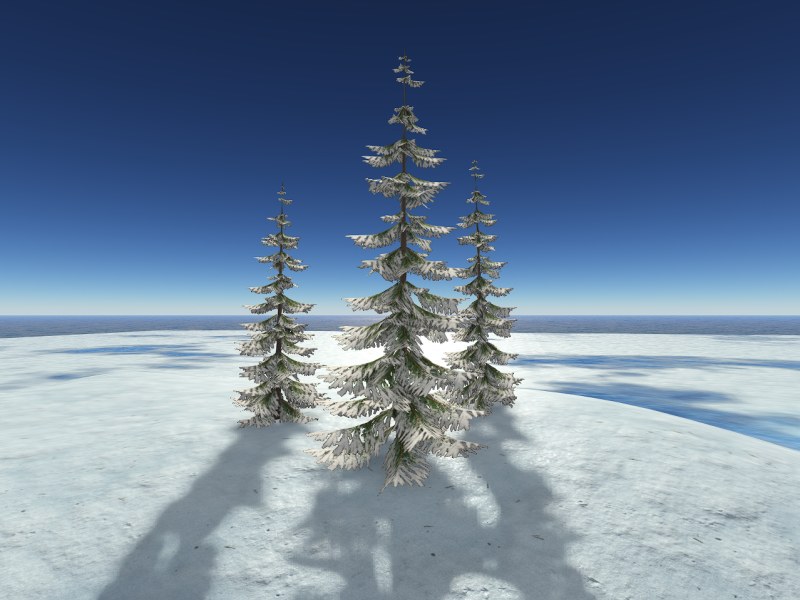
Pine 2

Pine 2

tree

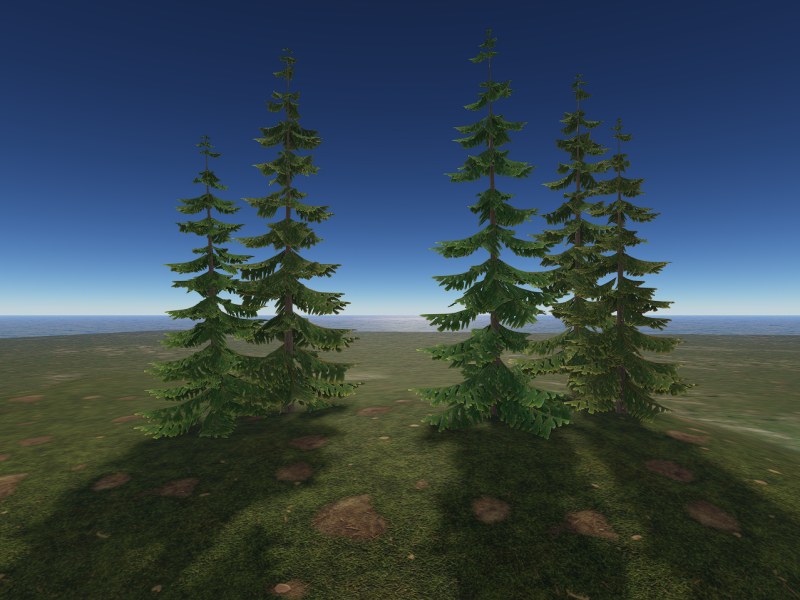
A tall conifer with a dense, narrowly conical crown and dark green foliage that extends nearly to the ground. Pine trees work well as windbreaks, privacy screens, or focal points in larger landscapes where their height can develop freely without crowding from nearby structures.

Not for Not suitable for tight spaces or small residential gardens where their mature height would dominate the area.
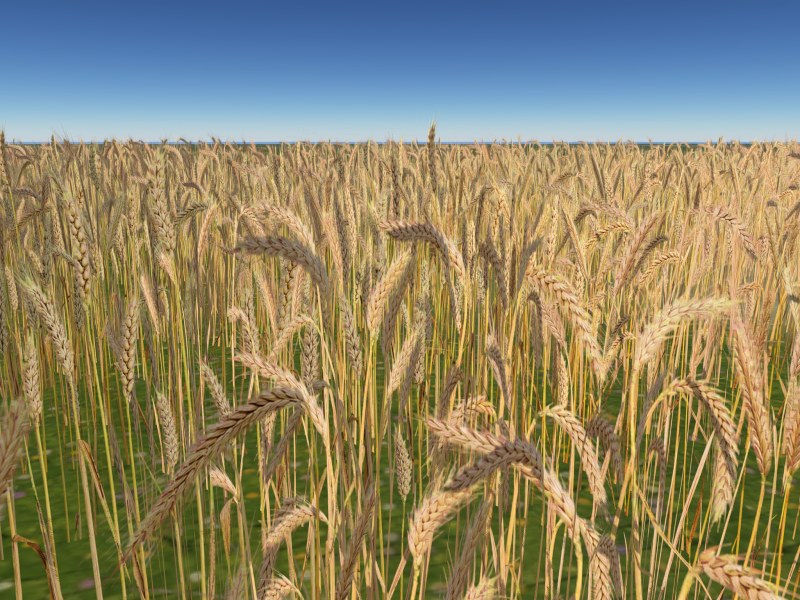
Barley

Barley

grass

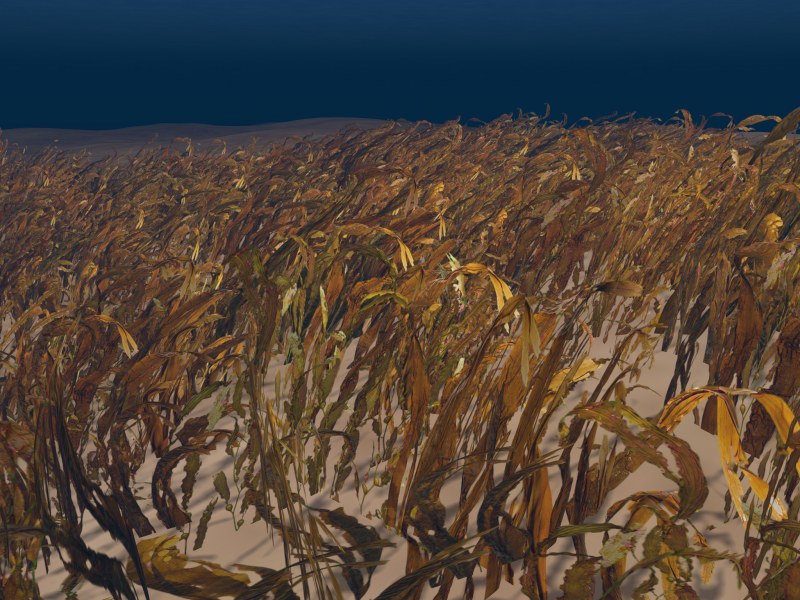
Ripening barley, chest high, each straw carrying one heavy bearded ear. A crop is not a meadow: plant it in rows or at least in a clearly bounded block, with a headland of bare ground or short grass around the edge. The spread of size and tilt is deliberately narrow here, because a field that varies as much as a meadow stops looking sown.

Not for Out of place anywhere nobody could plausibly have ploughed.
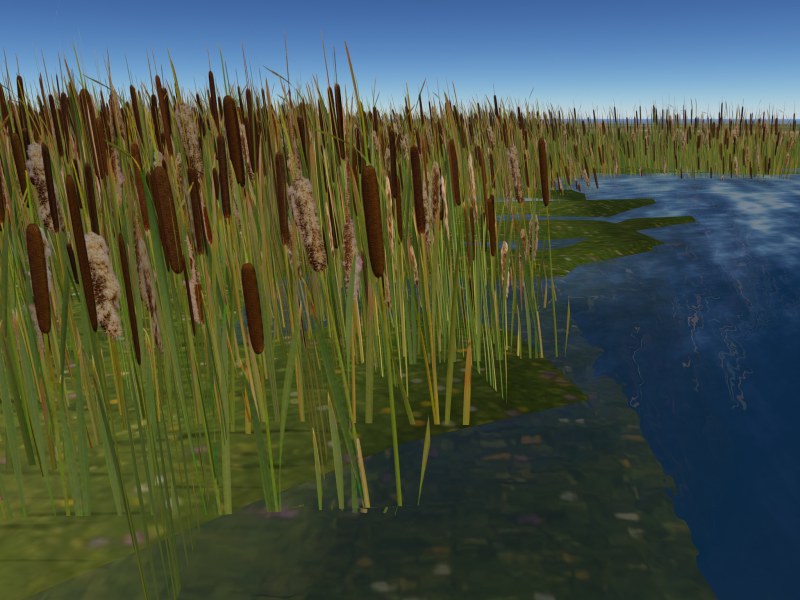
Cattail

Cattail

grass

Cattails with their dark brown velvet heads, for the wettest ground of all: ditches, pond margins, the still corner of a lake. They stand stiffer than reed and read from further away because of the heads. A few among a band of reed is more convincing than a stand of them alone.

Not for Too distinctive to repeat often · a wall of cattails looks stamped.
Fern

Fern

grass

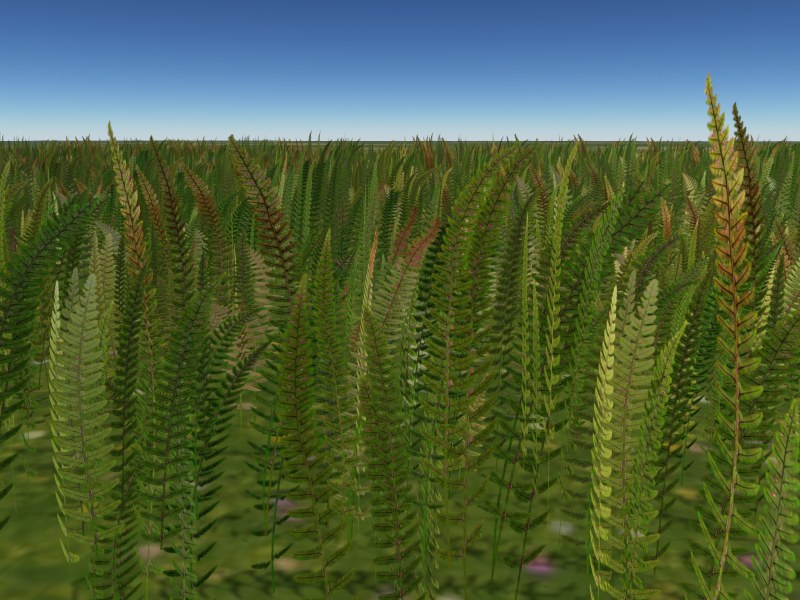
Fern fronds on their own stalks, deep forest green. Ferns want shade and damp: north sides, hollows, the lee of rocks and the edge of streams. They barely move, which is right · a fern in a gale looks like a mistake. Three or four together read better than a dozen spread out.

Not for Wrong in full sun and wrong on dry ground.
Marram grass

Marram grass

grass

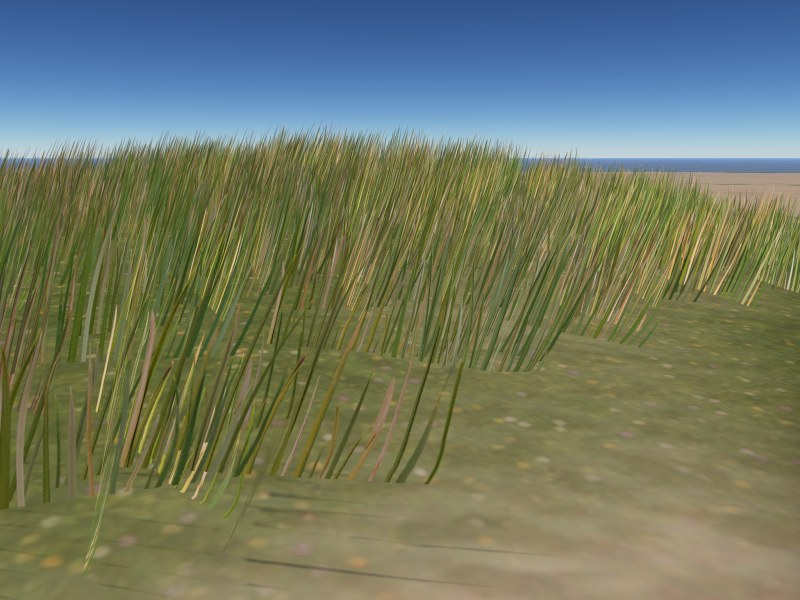
Stiff grey-green dune grass for sand and dry poor ground. It is the plant that makes a beach look like a coast rather than a sandbox, and it takes a lot of wind because nothing shelters it out there. Plant it in straggling lines along the crest of a dune, thinning towards the water.

Not for Looks starved on good soil · use meadow grass there instead.
Meadow grass

Meadow grass

grass

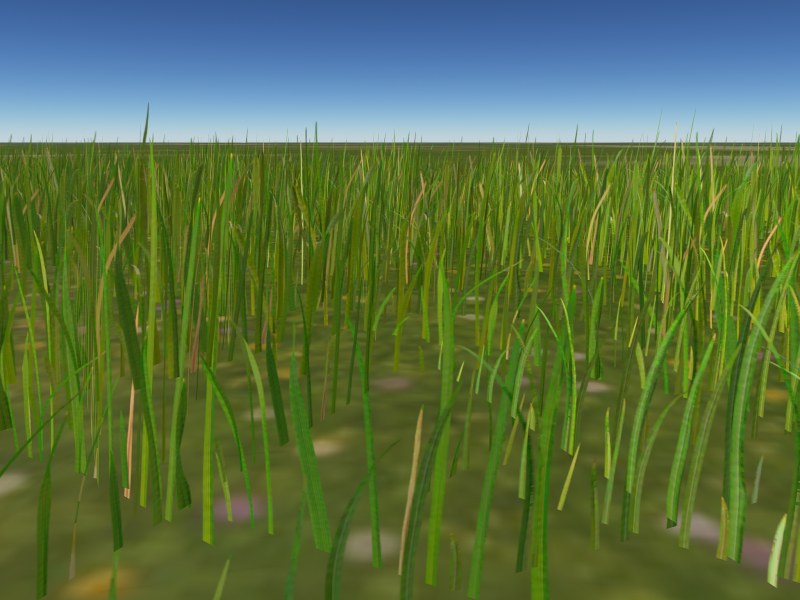
Ordinary green meadow grass, knee high, in full growth. This is the workhorse of the library and the one to reach for when in doubt. It sits well against almost any ground texture and moves clearly enough in the wind to be noticed without becoming restless. Vary the spacing: grass grows in patches with gaps between them, never at an even pitch.

Not for Wrong on dry or sandy ground, where it looks watered.
Reed

Reed

grass

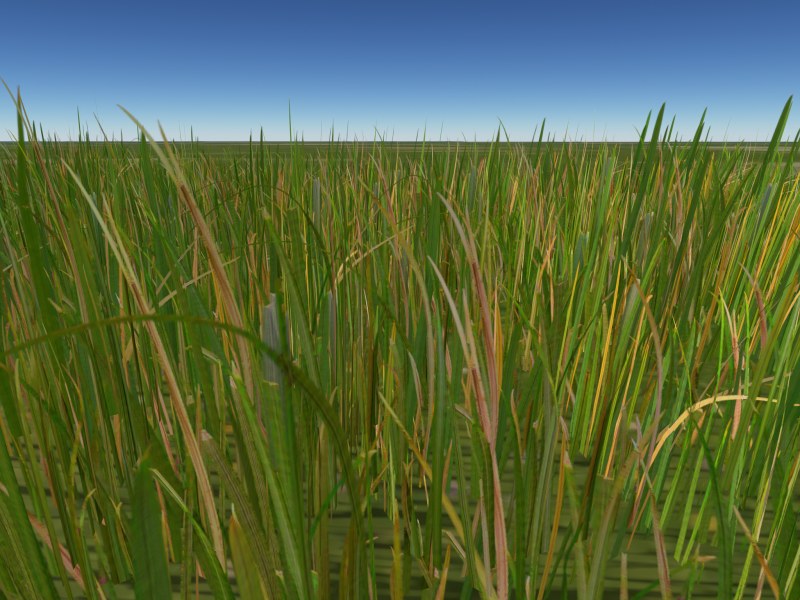
Tall reed for the edge of standing water, head high, with soft brown plumes on some of the stems. Set it in a band along a shoreline rather than in clumps · reed grows where the water is shallow, so it belongs in a line that follows the depth. It is given plenty of wind on purpose, because reed that stands still looks dead.

Not for Nonsense away from water · it is the surest sign of a shoreline.
Short lawn

Short lawn

grass

Short cropped grass, ankle high, the kind that grows where people walk and animals graze. Use it as the base layer over open ground: it fills the space between taller planting and takes the bare look off a terrain texture without drawing attention to itself. Plant it densely; it is meant to be read as a surface, not as individual plants.

Not for Too short to read from more than about twenty metres away.
Tall grass in seed

Tall grass in seed

grass

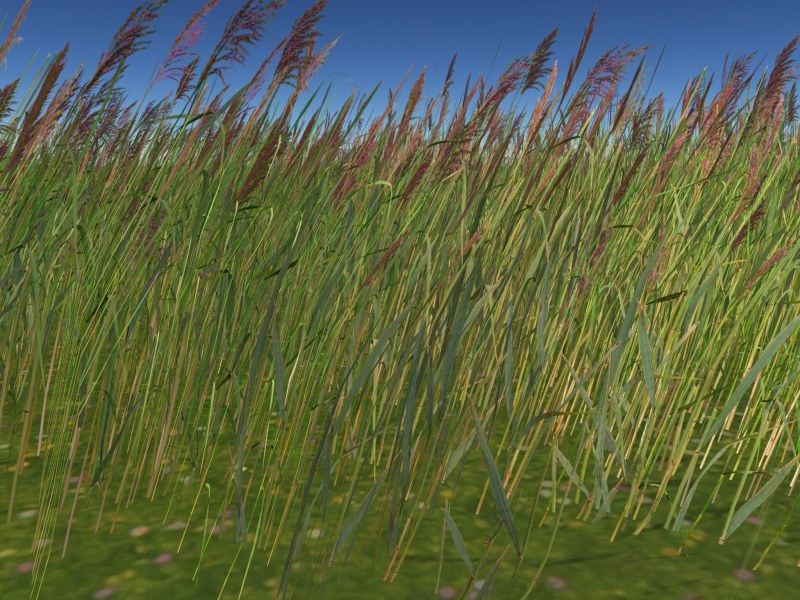
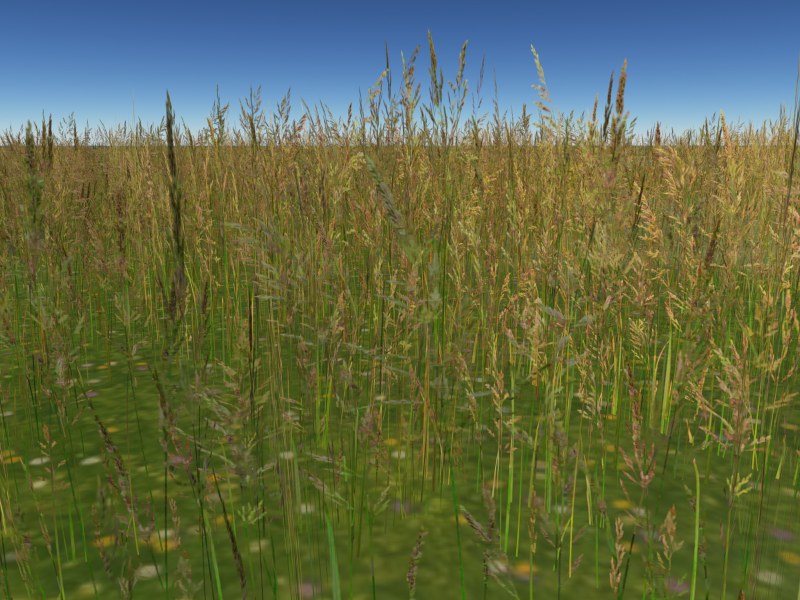
Waist high grass gone to seed, with loose feathery panicles above the leaves. This is the plant that shows the wind best: the heads are light and far from the root, so they swing where shorter grass only trembles. Good along fences, at the foot of walls and anywhere a mower would not reach.

Not for Hides small objects at its feet · keep it off paths and doorways.
Water weed

Water weed

grass

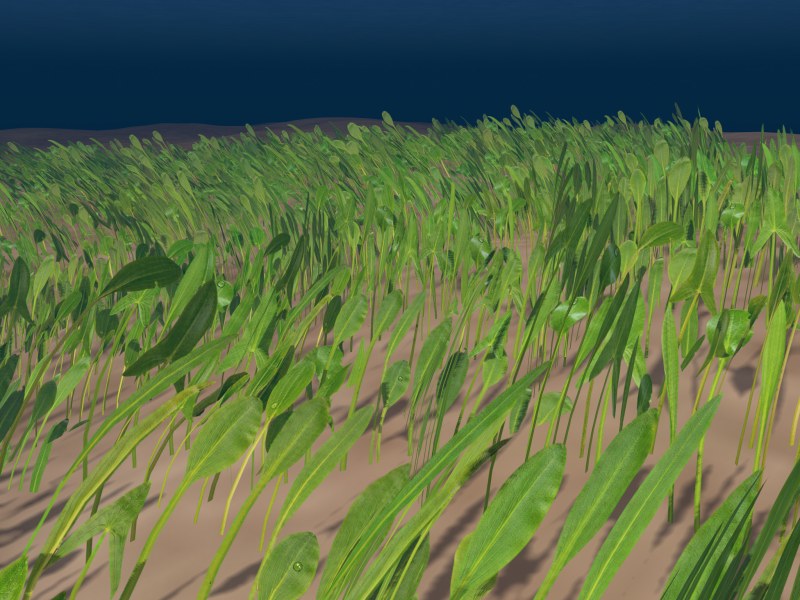
Limp ribbon weed for shallow water, meant to be planted below the surface. The settings are the opposite of everything else here: almost no stiffness, a lot of drag and a lot of wind, so it drifts slowly instead of flicking. Set it deep enough that the water line cuts across it.

Not for Absurd on dry land, where it hangs like wet washing.
Water weed

Water weed

grass

Limp ribbon weed for shallow water, meant to be planted below the surface. The settings are the opposite of everything else here: almost no stiffness, a lot of drag and a lot of wind, so it drifts slowly instead of flicking. Set it deep enough that the water line cuts across it.

Not for Absurd on dry land, where it hangs like wet washing.
Woodland undergrowth

Woodland undergrowth

grass

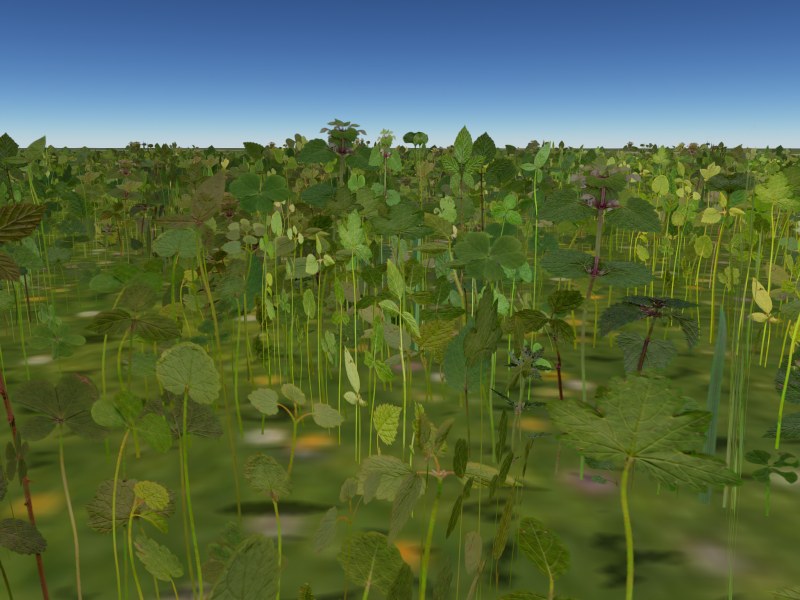
Low broad-leaved plants for the floor of a wood: sorrel, ivy shoots, odd single leaves. Shade green and matt, with almost no movement, because little wind reaches the ground under trees. This is what makes a stand of mesh trees stop looking like models standing on a lawn · the trees hold still, and something at their feet does not.

Not for Looks wrong in the open, where its shade colour reads as unhealthy.
Wildflowers

Wildflowers

flower

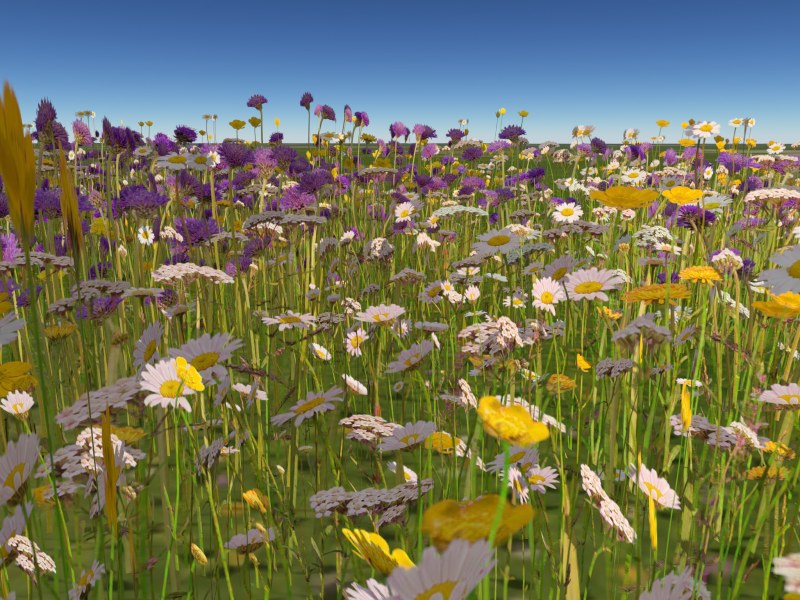
Meadow flowers on thin stems, standing above the surrounding grass. A handful of these does more for a landscape than a hundred plants of anything else, so plant them sparingly and in loose groups rather than scattered evenly. The colour of a group is fixed when you plant it, so a field can hold several colours at once without them mixing.

Not for Overwhelming in quantity · a solid bed of them reads as a garden, not a meadow.
Still in Blender
More is on the way

Around five trees, five grasses and five flowers to start, and the library grows from there. We would rather name what exists than promise a number.

The limits

Three rules, so the landscape holds together.

Size and rotation are yours to change. This is not about controlling what you do with your parcel. It is about the neighbourhood staying liveable.

Plants do not glow Fullbright and glow are off. A forest that lights up at night is the exact thing a curated library is meant to prevent.
There is a ceiling Twenty metres. A tree stays a tree, and does not become a tower with leaves on it.
They cannot be copied or passed on Not to restrict you, but because a copyable one-impact plant is the obvious way to build a wall out of forty trees.
How to begin

Take a region, walk it, and put something where it belongs.

Every plant in this library was made for this grid and is free to place. Newcomers get 512 m² of their own, so there is ground waiting before you have spent anything.

Worth knowing

The species names in the build tool come from 2004 and live on your own computer, so we cannot change them. Our plants are matched to them: our pine sits on Pine 1, our reed on Reed. Pick the name that sounds right and you will get ours.

Groundwork

The pieces that hold a continent together.

One argument, told from several directions: the things nobody sells, because nobody could make money on them, are the things a world is actually made of.

Piece one you are here
Planting

A tool from 2004 that everybody abandoned, filled with plants that cost one land impact each.

The rest being written
Still to come

The railway, the roads and the pod network are drafted but not written. They appear here as each one is finished, and not before.